 Denys Hargrove
Key Takeaways
- A Dacor range hood light reset — switch off, cut power at the breaker for a minute, restore, and try again — clears most light faults on its own.
- NO-LIGHT is separate from any fan fault; check the bulb, its seating, and a shared breaker before assuming the driver board has failed.
- FAN-NOISE is most often caused by a grease-loaded fan wheel becoming unbalanced — filters play a bigger role in preventing it than owners expect.
- A sudden rattle points more at something loose, like a duct connector, while a gradually worsening one points at grease buildup.
- Two resets is a reasonable ceiling — if the second attempt behaves the same as the first, check the bulb and socket directly instead.
The Bottom Line
Try the reset sequence once or twice for a light fault, and keep filters and the fan wheel clean to prevent most noise complaints. A light and fan failing together, or a reset that doesn't hold, is worth a proper diagnosis rather than a third attempt.
Few maintenance tasks on this site are as simple, or as often searched, as clearing a range hood light that has stopped working, because the light circuit on a range hood is separate from the fan circuit — and owners are often surprised that a hood can lose its light entirely while the fan keeps pulling smoke and steam without any trouble. This guide covers the reset itself, the maintenance that prevents most light and noise complaints, and the two codes worth knowing if a simple reset doesn't clear the problem.
| Symptom | Likely cause | What usually helps |
|---|---|---|
| Light out, fan works fine | Bulb failed, or light circuit tripped separately | Bulb swap, then a light reset |
| Light flickers before going out | Loose bulb connection or failing driver | Reseat the bulb, check the fixture |
| Rattling or grinding noise | Grease-loaded fan wheel, loose mounting | Clean filters, check blower mount |
| No light and no fan | Shared power or control fault | Check breaker, then a proper diagnosis |
How Do You Do a Dacor Range Hood Light Reset?
On most Dacor range hoods, the light circuit responds to the same basic sequence: switch the light off at the hood's own control, cut power to the hood at the breaker for about a minute, then restore power and try the light control again before touching the fan. This clears a light circuit that has tripped or locked up on its own, which is the single most common reason a hood's light stops responding while the fan continues working normally.
If the light comes back briefly and then fails again, or if it never responds at all after the reset, the fault has moved past a simple lockup and into either the bulb, its socket, or the driver board feeding it — worth knowing before you repeat the reset multiple times expecting a different result. Two resets is a reasonable ceiling: if the second attempt behaves the same as the first, further resets are unlikely to change the outcome, and the time is better spent checking the bulb and its socket directly.
It is also worth confirming which control actually governs the light on your model. Some hoods pair the light with the lowest fan speed setting rather than giving it a fully independent switch, and what looks like a light fault is occasionally just the control set to a mode where the light is not expected to be on.
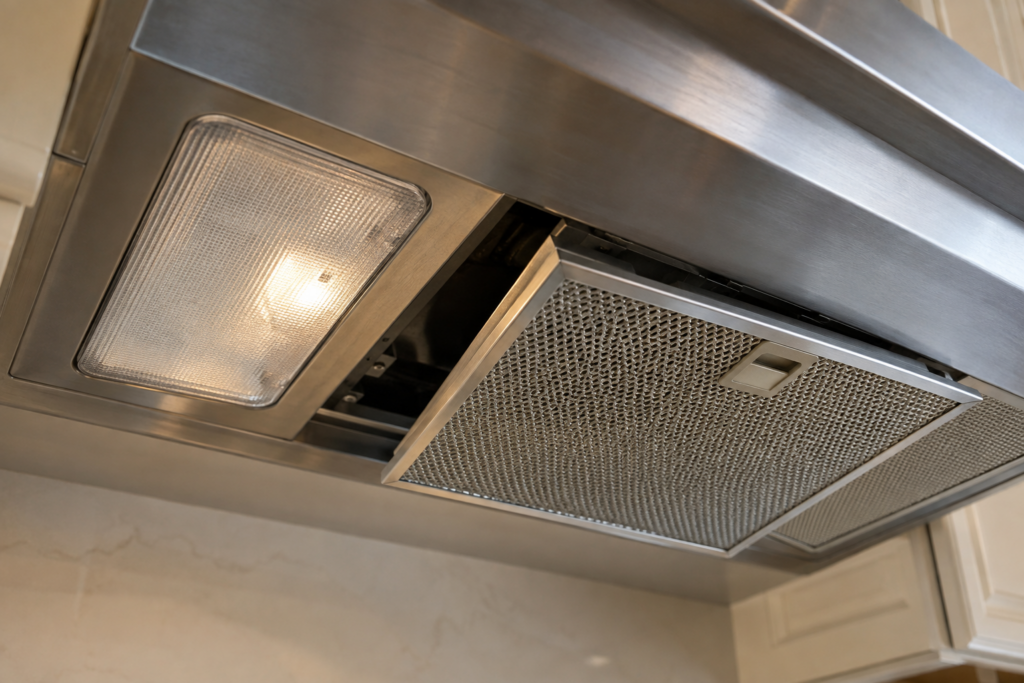
What Does the NO-LIGHT Code Mean?
The NO-LIGHT error code reports that the hood's lighting circuit is not responding as expected, separate from any fan-related fault. Before assuming a driver board has failed, work through the cheaper causes first:
- Confirm the bulb itself hasn't simply burned out, especially if the hood uses a standard replaceable bulb rather than a sealed LED module.
- Check that the bulb is seated fully in its socket — vibration from the fan running over time can work a bulb loose.
- Look for a separate light switch or control that may have been bumped or set to a dim level rather than off.
- Rule out a tripped breaker shared with another kitchen circuit before assuming the fault is inside the hood itself.
- Check for a blown fuse specific to the light circuit, if your model isolates lighting on its own small fuse separate from the fan.
A NO-LIGHT code that persists after a fresh bulb and a proper reset points at the driver board or wiring behind the fixture, which is a technician's job rather than a further round of resets.
What Causes a Range Hood to Rattle or Grind?
The FAN-NOISE code covers rattling or grinding sounds from the blower assembly, and grease buildup is by far the most common cause. A fan wheel that has accumulated grease over months of cooking becomes unbalanced the same way an unbalanced tire vibrates a car, and the noise gets worse gradually rather than appearing overnight. A loose mounting bracket produces a similar rattle but with a different rhythm — worth describing to a technician as precisely as you can, since the two faults have different repairs.
Filters play a bigger role in this than most owners expect. A grease-saturated filter forces the blower to work harder to move the same amount of air, and that extra strain accelerates wear on a fan wheel that may already be carrying some buildup of its own. The related range hood error code archive covers the fan and power faults that share a family with FAN-NOISE, including a full fan failure and a hood that draws no power at all, both of which are more urgent than a noise complaint alone.
A rattle that appears suddenly rather than building gradually is worth treating differently — a sudden noise more often means something has come loose or shifted, such as a duct connector or a mounting screw, rather than the slow grease buildup that produces a gradually worsening sound over months.
How Often Should You Clean and Check the Hood?
A short seasonal routine prevents most of what shows up on this page:
- Wash or replace grease filters monthly if you cook with high heat or oil regularly, quarterly at minimum otherwise.
- Wipe the light fixture and lens during the same cleaning pass, since grease film on the lens dims light output even when the bulb itself is fine.
- Check the bulb's connection for looseness every few months, especially on hoods mounted where vibration is more noticeable.
- Vacuum the light housing's vents, if it has any, since dust buildup there can trap heat around the fixture.
- Listen for a new sound after every deep clean, since a fan wheel or bracket disturbed during cleaning can shift slightly and start rattling.
- Replace bulbs with the manufacturer-specified type, since a mismatched bulb can run hotter than intended and shorten the fixture's life.
- Keep the exterior vent cap clear of debris, since a restricted exhaust path adds load to the same blower that is already carrying grease.
Our guide to downdraft vent troubleshooting covers the equivalent maintenance for a different style of ventilation — worth reading if your kitchen has both a hood and a downdraft system, since the filter routine is similar but the duct paths are not.
When a Reset Isn't Enough
If the light and fan both stop responding together, or if a reset clears the light only for it to fail again within a day, that pattern points at a fault beyond routine maintenance. Our is it worth repairing a Dacor range hood guide is worth reading if this is not the hood's first issue, since a light fault arriving alongside a fan or noise complaint changes that calculation.
Our range hood repair service covers the light circuit, the blower, and the driver board together, with a diagnostic that starts from $95 and is credited toward the repair if you approve the work. If the hood shows no light and no fan at the same time, check the breaker first and book a visit if it does not resolve.