 Denys Hargrove
Key Takeaways
- Clean the ice bin every three to six months, on the same day as the deep clean and the six-month water filter change.
- Wash the bin with mild dish soap and warm water, rinse it well and refit it only when dry.
- Do not use harsh chemicals or force parts, and follow your handbook for any model-specific procedure.
- A spent filter is a common reason for cloudy or off-tasting ice, so change it on schedule.
- If ice has stopped after cleaning, a new filter and a reset, book a diagnosis.
The Bottom Line
Empty and wash the bin, wipe the cavity, change the filter on schedule and discard the first ice. If production does not resume, book a diagnosis.
Nobody gets round to Dacor column refrigerator ice maker cleaning until the ice starts to taste of the freezer, even though the job is short. A column refrigerator is built into cabinetry and keeps its ice maker out of sight, so it is easy to forget that the bin, the tray and the water path need the same attention as the shelves. This guide covers a routine that fits a model with an ice maker, which our column refrigeration service page lists as an option rather than a given. It sets out when to clean, a step-by-step method, what the cleaning will not fix, and the codes on this site that point at the ice maker itself.
| What you notice | What it usually means | What to do |
|---|---|---|
| Ice tastes or smells stale | Old ice, a dirty bin or an expired filter | Empty and wash the bin, change the filter |
| Cubes are small, cloudy or clumped together | Restricted water flow, often the filter | Change the filter, then clean |
| Ice has stopped altogether | An ice maker fault or a freezer problem | Check the codes, then call |
| Bin has a film or white residue | Mineral buildup and spills | Wash and dry the bin |
How Often Should You Clean a Dacor Column Refrigerator Ice Maker?
Every three to six months, and whenever the ice tastes or smells wrong. Our Dacor refrigerator care guide puts a deep clean of the interior at every three to six months and the water filter at every six months, so the simplest routine is to clean the ice maker on the same day you do both. Fold the ice bin into that visit, because it is the part that gets forgotten.
A household that uses a lot of ice, or one that leaves the same ice sitting for weeks, benefits from cleaning on the shorter schedule. The ice itself is the early warning: if it clumps, clouds or smells, do not wait for the date.
What You Need Before You Start
A little preparation keeps the job quick and stops you creating a puddle.
- Your handbook, for how to switch the ice maker off and how to release the bin on your model.
- A bowl or cooler to hold the ice you remove, if you want to keep it for the freezer.
- Mild dish soap, warm water and soft cloths, and nothing abrasive.
- Towels for drips around the tray and the water line.
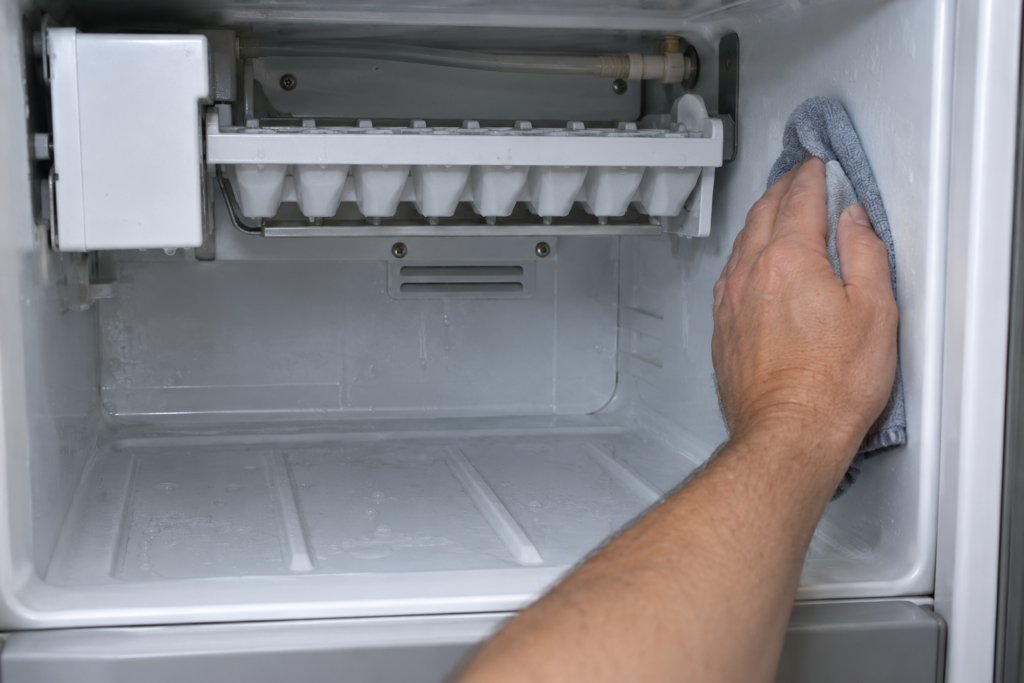
Step-by-Step Cleaning
The release varies with the model, so follow your handbook for any latch or tab. The order below is the same on any of them.
- Switch the ice maker off using its control or switch, so it does not drop ice while you work.
- Remove the bin and empty the ice into the sink or a cooler.
- Wash the bin in warm soapy water with a soft cloth, rinse it well and let it dry completely.
- Wipe the ice maker cavity and the surfaces around the tray with a cloth wrung almost dry, taking care not to wet any wiring.
- Look at the water line and the fill area for drips, mineral buildup or loose connections, and note anything that looks wrong.
- Refit the bin only when it is dry, then switch the ice maker back on.
- Discard the first batch of ice and the second if the filter was also changed.
Why discard the first ice? Because the freshly cleaned bin and cavity may still carry traces of soap or a taste from the cleaning, and the first cubes are the ones that pick them up. It costs a tray of ice and saves a glass of drink that tastes of dish soap. If you share the kitchen with others, tell them the ice maker is switched off while you work, so that nobody opens the door and wonders why there is no ice.
Never force a part that does not release, and do not pour water into the ice maker mechanism. Stop and call if anything is cracked, loose or wet where it should not be.
Can You Use Bleach or Harsh Cleaners on the Ice Maker?
No, not unless your handbook says to. Mild dish soap and warm water remove most of what builds up, and strong chemicals can leave a smell and taste that goes straight into the ice. Rinse the bin thoroughly after washing, since soap residue is as bad as the film you were removing.
If your model has a specific cleaning or sanitizing procedure in its handbook, follow that over any general advice, including this. The handbook knows your ice maker and we do not.
What Should You Do If the Ice Still Looks or Tastes Wrong?
Change the water filter, then check the codes. The care guide on this site says the water filter in Dacor column and French door refrigerators should be replaced every six months, and a spent filter is a common reason for cloudy or off-tasting ice. After a change, run water through to flush the line, and discard the first ice.
If the ice has stopped, the cleaning is not the answer. Three codes on this site mention the ice maker, though they are listed for French door and column models: E6, an ice maker fault on the DRF36 and DRF42, E2, a freezer sensor failure that can stop ice production, and FF, a freezer fan fault. The E6 page says an ice maker reset can clear a transient jam, and that production not resuming within 24 hours means more diagnosis is needed.
What Cleaning Will Not Fix
Cleaning handles buildup and stale ice. It does not touch the parts behind the bin.
- A water valve that buzzes with no water entering the mold, which the E6 page says needs valve replacement.
- A freezer that is too warm to make ice, from a sensor or fan fault.
- Weak flow after a new filter, which points at the supply line or the inlet valve.
Airflow matters too. Our column ventilation clearance notice says blocked toe-kick or top vents raise cabinet temperatures, which a freezer feels first.
When to Call Someone
Call if the ice maker is not working after a clean, a new filter and a reset, or if you see a leak. The column refrigeration repair service lists the ice maker among the problems it handles, and our column refrigeration repair cost guide shows what a visit involves. The final price is confirmed after diagnosis on site, with a written estimate before work begins. You can book a visit or send us the model number and what the ice maker is doing.