 Denys Hargrove
Key Takeaways
- A jammed Dacor coffee machine grinder is usually worth fixing, since the common causes cost nothing.
- GRIND-JAM means the burr grinder has stalled and the motor has shut off to protect itself.
- A foreign object, oily residue on the burrs or a grind setting that is too fine cause most jams.
- Empty the hopper, vacuum the chute and set the grind two or three positions coarser before booking a visit.
- Worn or chipped burrs, or a motor that does not spin freely, are technician repairs that start from $200.
The Bottom Line
Empty the hopper, check the beans by hand, vacuum the chute and grind coarser. If GRIND-JAM stays, a technician repair from $200 is usually worth it on a machine that is otherwise sound.
When the grinder in a Dacor built-in coffee machine seizes, it usually does so with a harsh scraping noise, then silence, and then a cup of nearly clear water. The display shows GRIND-JAM, the grinder motor shuts itself off to protect against overload, and every brew button gives the same answer. For an owner who paid for a statement appliance, the instinct is that a grinder repair must be expensive and that the whole machine is in doubt. The facts on this site's own pages say otherwise. Most causes are things in the beans or on the burrs, and the cases that need a technician are easy to recognize.
| What you find | What it means | Worth fixing? |
|---|---|---|
| A stone or packaging fragment in the beans | A foreign object wedged between the burrs | Yes, if it can be removed safely |
| Thick residue on the burrs from oily beans | Grounds clumping instead of flowing | Yes, cleaning often solves it |
| Grind set extremely fine | Powder compacting in the chute | Yes, move the dial coarser |
| Visible wear grooves or chipping on the burrs | Worn grinder parts | Get a quote; usually worth it on a sound machine |
| Motor does not spin freely when tested | A failed or seized grinder motor | Weigh the quote against the machine |
Is a Dacor Coffee Machine Grinder Worth Fixing?
Usually yes, because the common causes cost nothing and the technician repair is small beside the cost of the machine. This site's GRIND-JAM page puts the repair at from $200 and rates roughly 40 percent of cases as something an owner can fix. The final price is confirmed after diagnosis on site, with a written estimate before any work begins.
The question changes only if the grinder is one of several problems. The site describes the CM24 as the only factory-integrated automatic espresso and coffee machine Dacor has produced, so a built-in that is otherwise healthy is worth keeping, and a grinder fault on its own does not change that.
What Does GRIND-JAM Mean on a Dacor CM24?
It means the internal burr grinder has stalled. The machine monitors the grinder motor's current and rotation speed, and when the grinder stops turning it shuts the motor off and shows the code. The page says a jammed grinder can overheat the motor, so do not try to grind more beans until it is cleared.
- A harsh noise, then silence — the grinder scrapes or clicks and stops completely.
- Water in the cup — the cycle runs but no grounds reach the brew chamber.
- The same error on every button — it persists until the cause is cleared.
- Weak coffee beforehand — a partial blockage gives inconsistent doses before a full jam.
The Three Causes You Can Clear Yourself
Each of the three causes the page lists as do-it-yourself is a matter of beans, residue or settings. They are the right place to start before any quote, and they are why the repair is so often unnecessary.
- A foreign object in the grinder — a small stone, twig or piece of packaging mixed in with the beans, which wedges between the burrs.
- Oily bean residue on the burrs — dark-roasted or oily beans leave a coating that makes grounds clump and pack instead of flowing.
- A grind setting that is too fine — the burrs make powder that compacts and blocks the chute.
Small stones are often the same size and color as coffee beans, so the page's advice is to feel through the beans by hand before refilling.
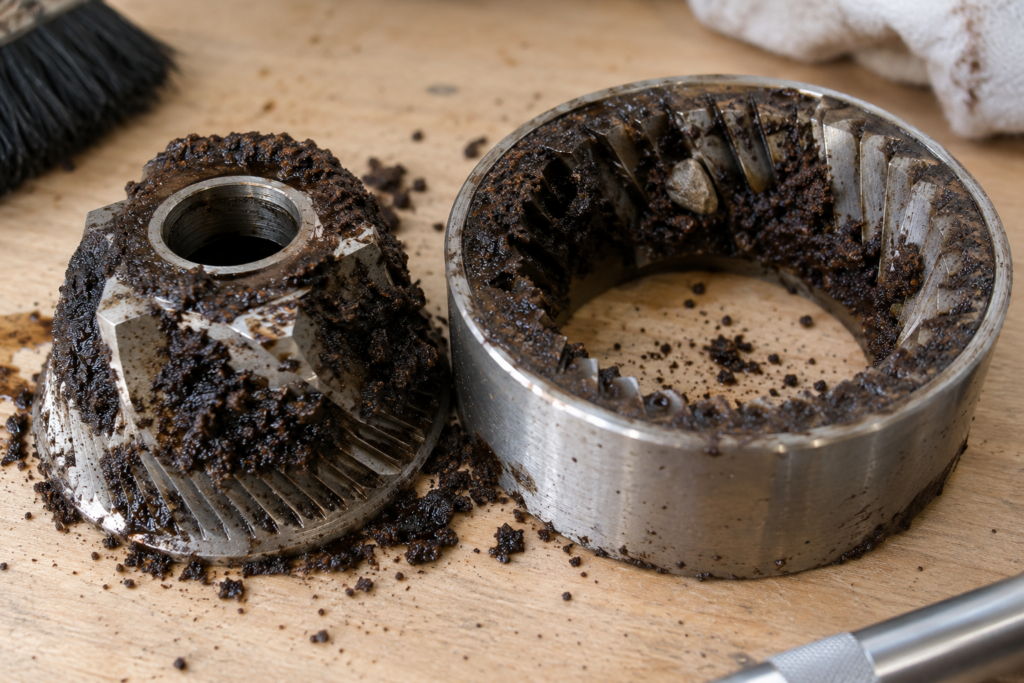
Clearing a Grinder Jam Step by Step
The steps come from the code page and need no tools beyond a flashlight and a vacuum cleaner with a narrow nozzle. Do not disassemble anything.
- Turn the machine off, remove the hopper lid and scoop out every remaining bean.
- Look into the grinder throat with a flashlight for stones or packaging fragments, and pick through the beans by hand.
- Unplug the machine and vacuum the grinder chute, clearing compacted grounds from both ends of the path to the brew chamber.
- Move the grind dial two or three positions coarser, then run a test brew and fine-tune back gradually.
- Restart the machine and see whether GRIND-JAM stays away.
If you recently switched to a darker, oilier bean, a coarser setting is often needed. Very oily beans can clog even a well-kept grinder.
When Is the Grinder No Longer Worth Fixing?
When the jam is not the whole story. The page says to call a professional if a foreign object is visible but cannot be retrieved without disassembly, if the burrs show wear grooves or chipping, or if the grinder motor does not spin freely when a technician tests it. Stop at once if the code persists after the hopper is emptied and the machine restarted, or if you smell burning from the grinder area.
Worn burrs or a failed motor are real repairs, but they are repairs on a machine that otherwise works. Even then the answer depends on age and condition, and the useful question for the technician is what the whole machine needs, not only the grinder. Our Dacor coffee machine error codes guide shows the other codes to watch for on the CM24.
What a Grinder Visit Involves
A visit for a grinder fault is more than a part swap, and knowing the steps helps you judge a quote. This site's coffee machine repair page describes the work in three stages that apply here.
- Diagnosis — a brew pressure test, a boiler temperature check and a scan of the control board for fault codes, so the grinder is not blamed for another fault.
- Grinder burr inspection and calibration — a look at wear grooves and chipping, and a check that the grind adjustment is working as it should.
- A written estimate — approved before any work begins, so you decide on a known figure.
The page also notes that the machine combines a burr grinder, a boiler, a pressurized brew group and electronic controls in one built-in unit. Because of that, a grinder jam that keeps returning can be a symptom elsewhere, and a thorough diagnosis is worth more than a quick part swap.
Keeping the Grinder Out of Trouble
Prevention is the same short list as the causes. Sift beans by hand before filling the hopper, use a grind setting that suits the roast, and clear residue now and then. Our guide to Dacor coffee machine care covers the wider routine.
When you book, tell the technician what the grinder sounded like, which beans you use, and what you already cleared. Our coffee machine repair service covers grinder burr inspection and calibration. When you are ready, book a visit or send us the model number and the code on the display.