 Denys Hargrove
Key Takeaways
- A Dacor wine cooler fan repair starts from $250, with the final price confirmed after diagnosis on site.
- The fan circulates air so every shelf holds the same temperature, and without it the cabinet stratifies.
- Address a FAN-FAIL within about 48 hours so that stored wine does not degrade over time.
- Clear any bottle, cork or label touching the blade and power-cycle for 60 seconds before booking.
- A fan that hums and stops, or a motor that tests open circuit, is a technician repair.
The Bottom Line
Clear the blade and power-cycle first. A fan that still fails starts from $250 to repair, and it is worth addressing within 48 hours.
A Dacor wine cooler fan replacement cost is a smaller question than the fault code suggests, because the fan is not the part of the cabinet that makes the cold. The compressor does that. What the fan does is move the air so that every shelf sits at the same temperature, and when it stops, the compressor keeps running and the cabinet quietly separates into warm and cold layers. Owners notice a code on the display, or a bottle on the top shelf that feels warmer than the one below it. The repair bill depends on whether the fan is blocked, burned out, or simply not being told to run.
| What you notice | Likely cause | Cost note |
|---|---|---|
| FAN-FAIL, a bottle or cork touching the fan blade | An obstruction tripping the overload protection | No cost; clear it and power-cycle |
| Fan hums briefly, then stops | Motor winding failure | Replacement, from $250 |
| Motor tests normal but does not spin | The board's fan drive circuit | Technician repair, from $250 |
| Upper shelves warmer than lower ones | No air circulation in the cabinet | Book promptly; see below |
How Much Does a Dacor Wine Cooler Fan Replacement Cost?
A fan repair starts from $250, according to this site's FAN-FAIL page, and the page puts a professional visit at 45 to 90 minutes. That is a starting figure and not a quote, because the fault could be the motor, the board or an obstruction that costs nothing. The final price is confirmed after a technician has diagnosed the cabinet on site, and you get a written estimate before any work begins.
The page covers the HWC242, the Heritage wine cellar and the Modernist wine column, and it rates the do-it-yourself share at about 25 percent. The cheap cases are the ones you can see: something is in the way of the blade.
Why Does a Wine Cabinet Need a Working Fan?
Because without it the temperature stratifies. The page says a stopped fan leaves bottles on different shelves at noticeably different temperatures, upper shelves warmer and lower ones colder, and that the compressor alone cannot hold the cabinet evenly. Wine is not ruined immediately, but the page advises addressing the fault within 48 hours so that quality does not degrade over time.
That 48-hour window is the practical limit on how long you can shop around. It is not a reason to panic, but it is a reason not to leave a FAN-FAIL until the next convenient month.
- Upper shelves warmer than lower ones — the signature of a cabinet with no air movement.
- The cabinet above its set point — the compressor alone cannot cool the whole space evenly.
- No air felt with your hand inside — a working unit has a faint circulation you can feel.
- FAN-FAIL on the display — the fan circuit has reported a fault.
If you see more than one of these, treat the fan as the suspect and move the most valuable bottles to a stable spot while you wait.
What You Can Check for Nothing
Three checks cost nothing, need no panels removed, and tell you whether the repair is a repair at all. They are the same ones the code page lists as safe for owners.
- Look for an obstruction. Find the circulation fan, usually at the rear of the cabinet or behind an interior panel, and look for bottles, corks, labels or debris touching the blade.
- Remove anything in the way and listen for the fan to restart.
- Power-cycle the cabinet. Unplug it for 60 seconds, restore power and listen for the fan to start within 30 seconds.
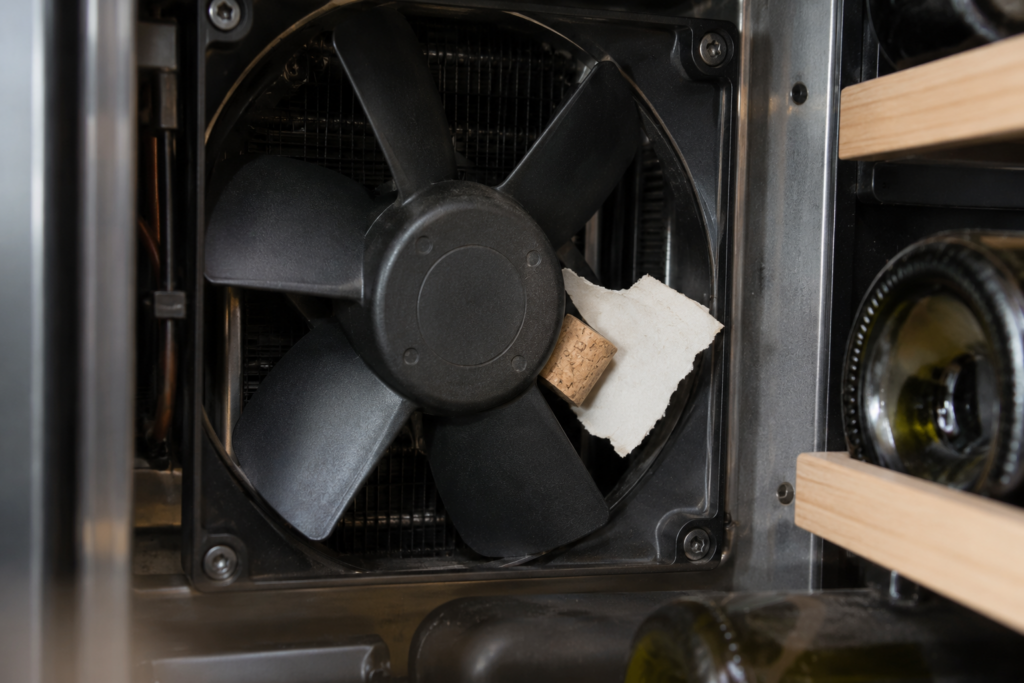
The sound tells you which side of the line you are on. A fan that restarts was probably blocked, and a brief hum that then stops points to the motor failing and not being obstructed. If FAN-FAIL returns after you have cleared the blade and power-cycled, stop and book a visit.
Can You Test the Fan Motor Yourself?
The code page describes a continuity test, but it needs a multimeter and some confidence. With the unit unplugged, the motor connector is disconnected behind the interior panel and the resistance across the terminals is measured. A reading of OL, an open line, means the motor has burned out and needs replacing. The page adds that these are low-voltage DC fan motors, so the replacement has to match the model number.
If you are not comfortable removing an interior panel, leave this to a technician. The page is clear that on Heritage wine cellar models the motor can be inaccessible without removing the whole interior panel, which it counts as professional scope.
What Decides the Price
Three situations produce three different bills, and a diagnosis tells you which one you are in.
- Motor open circuit — the motor itself is replaced, and the page treats this as the standard replacement case.
- Motor correct but not spinning — the fault is in the board's fan drive circuit, which is a different repair from a new motor.
- Access to the fan — on a Heritage wine cellar, reaching the motor can mean removing the full interior panel, which adds labor.
The page gives a single starting figure, so ask the technician for a written estimate after the diagnosis and check that it names the part.
Keeping Bottles Clear of the Fan
Most obstructions are preventable. The page notes that open shelving can let cork fragments or bottle necks reach the fan if bottles are stored on the wrong shelf or at an angle. A few habits reduce that.
- Store bottles flat or as the shelf is designed to hold them and not tilted toward the rear.
- Keep labels and loose corks out of the cabinet, since both can drift toward the airflow.
- Check the rear of the cabinet when you reload it, so nothing is leaning against the fan area.
Is a Fan Repair Worth It?
On a cabinet that is otherwise sound, yes. A fan fault is contained and the compressor and the rest of the cabinet are untouched. The cost of a fan is also small beside the value of the wine it protects, and the 48-hour guidance means you can ask for a written estimate and compare it without the cabinet being at risk of anything worse than uneven temperatures. If the compressor is also failing, the decision is a different one, and our guides to a Dacor wine cooler compressor worth repairing and Dacor wine refrigeration repair or replace cover that.
The wider list of wine cabinet codes is in our Dacor wine cooler error codes guide. Tell the technician the model, what the display shows and what the fan does when you restore power. Our wine refrigeration repair service covers fans, boards and compressors. When you are ready, book a visit or send us the model number and the code.