 Denys Hargrove
 Key Takeaways
- TEMP-HI and TEMP-LO report a measured condition, not a failed part — the cause can be a door, a warm load, or a genuine fault.
- FAN-FAIL explains the classic complaint of a correct display reading with a warm top shelf: the cabinet is cooling but not circulating.
- A bottle, shelf, or loose label against the fan grille can trip the same code as a failed motor, so check the airway first.
- COMP-ERR means no cooling at all — move the bottles somewhere cool and dark rather than power-cycling the cabinet repeatedly.
- PF is a power failure notice; the display recovers long before a full cabinet of wine does.
The Bottom Line
Read TEMP-HI and TEMP-LO as symptoms and FAN-FAIL and COMP-ERR as components. Clear the simple causes — door, load, airway, clearances — and treat a compressor fault as urgent, because a wine cabinet gives you hours rather than days.
| Code | What the cabinet is reporting | What it means for the bottles |
|---|---|---|
| TEMP-HI | Cabinet is warmer than its setpoint | Act now — sustained warmth is what ages wine badly |
| TEMP-LO | Cabinet is colder than its setpoint | Risk of chilling past the point corks tolerate |
| FAN-FAIL | Circulation fan has failed | Zones stratify: top shelf warm, bottom shelf cold |
| COMP-ERR | Compressor fault | No cooling at all — treat as urgent |
| PF | Power failure notification | Check how long it was off before judging anything else |
TEMP-HI and TEMP-LO Describe the Cabinet, Not the Cause
Both temperature codes report a measured condition rather than a broken part. The cabinet is telling you it has failed to hold the setpoint, and the reason can be anything from a door that did not latch to a compressor that has stopped. That makes them the codes most worth investigating rather than clearing. Start with what you control. A cabinet loaded warm — a case brought in from a hot trunk — will read high for hours and that is normal. A door propped by a bottle that sits slightly proud of the shelf will read high forever. Direct sun on the glass, or a cabinet installed with no breathing room at the plinth, will do the same. TEMP-HI that persists with the door properly shut and the load settled is a genuine fault. TEMP-LO is rarer and usually points at control rather than capacity: a setpoint someone changed, a dual-zone cabinet with its zones confused, or a thermistor reading low. It matters more than owners assume, because wine held too cold dries corks and pushes sediment out of solution.FAN-FAIL Is Why One Shelf Is Wrong and the Others Are Fine
The circulation fan is what makes a wine cabinet a wine cabinet rather than a small refrigerator. It moves air evenly so that every shelf sits within a degree or two of the same temperature, and in a dual-zone unit it is what keeps the two zones honest. When FAN-FAIL appears, the compressor usually keeps running and the cabinet keeps cooling — it simply stops distributing that cold.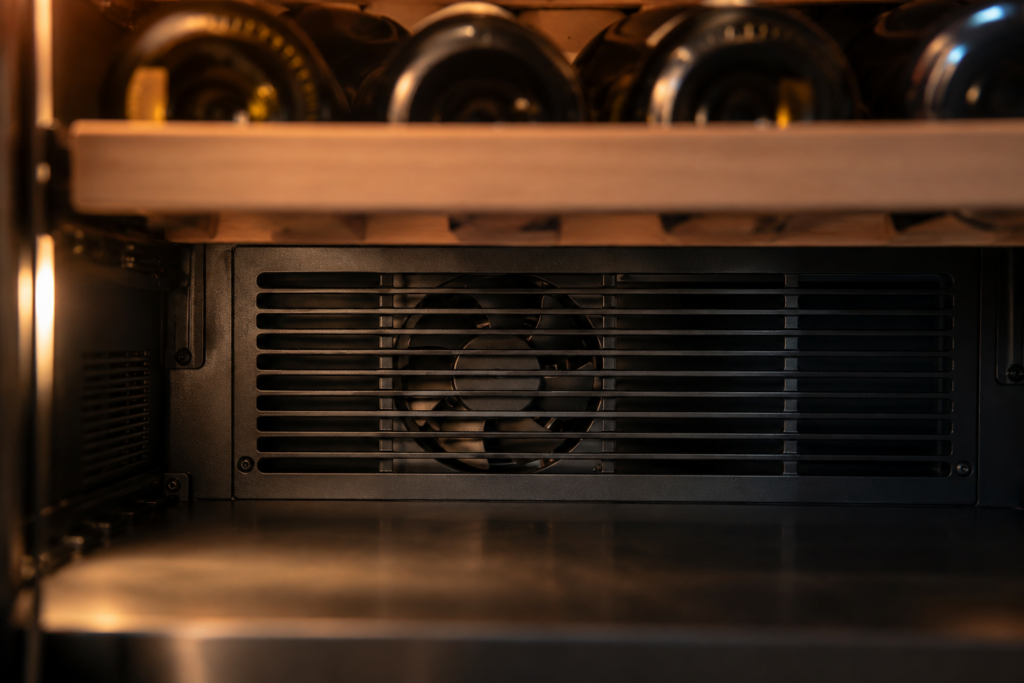
COMP-ERR Is the One That Cannot Wait
A compressor fault means no cooling is happening at all. Depending on the ambient temperature of the room, a well-insulated cabinet will hold acceptable temperatures for a matter of hours, not days. If COMP-ERR appears and the interior is climbing, move the bottles you care about into a cool, dark place — a basement or an interior closet beats an improvised ice chest — and deal with the cabinet afterward. Do not run a cabinet in and out of power trying to make the code clear. Short-cycling a compressor that is already struggling is how a repairable fault becomes a sealed-system replacement, which is the point at which the decision stops being about parts. Our guide on whether to repair or replace a wine cabinet walks through that fork honestly.PF Tells You About an Outage You May Have Slept Through
PF is a notification that power was lost. On a wine cabinet this is more useful than it sounds: a four-hour outage in summer can put a full cabinet well above its setpoint, and the display will show a normal reading again long before the bottles have recovered. Treat PF as a prompt to check how long the interruption lasted, then give the cabinet time to pull back down before judging its performance.- Clear the code and watch, don't clear the code and forget. Note the temperature when you clear it, and again two hours later.
- Repeated PF without neighborhood outages points at the circuit, not the cabinet — a shared breaker or a loose connection.
- Check the door seal after any long outage. Condensation that formed during the warm spell can leave a seal sitting proud.
- Do not stack the recovery. Adding a warm case while the cabinet is still catching up will produce TEMP-HI on top of it.