 Denys Hargrove
 Key Takeaways
- F3 is a door interlock fault — stop using the microwave, switch off the breaker, and have it inspected before it runs again.
- SE means the control sees a key held down; grease or a dried spill under the membrane is the usual cause, and a clean often clears it.
- F2 is the temperature sensor and F5 the humidity sensor: manual time-and-power cycles still work, automatic modes do not.
- F1 is a control board fault, which is why its symptoms are vague — a single one after an outage may clear, a recurring one will not.
- PF is only a power failure notice; repeated PF without outages points at the circuit rather than the appliance.
The Bottom Line
Treat F3 as a stop-now code and everything else as a component to diagnose. Clearing power, cleaning the keypad, and degreasing the cavity are the only owner checks worth making, because the capacitor inside a microwave stays charged after it is unplugged.
A built-in microwave is the appliance owners are least willing to live without and least inclined to investigate. It sits at eye level, it gets used a dozen times a day, and when a two-character code replaces the clock the whole kitchen notices. One of those codes — the Dacor microwave F3 error code — is a reason to stop cooking the same minute it appears. The good news is that Dacor microwave error codes are specific: each one names a circuit, and two of the six are not faults at all. The bad news is that one of them is a reason to stop using the appliance immediately.
| Code | What the control is reporting | Safe to keep using? |
|---|---|---|
| PF | Power failure — the clock lost time | Yes, once the code is cleared |
| SE | Stuck or shorted keypad key | No — the oven may start on its own |
| F1 | Control board fault | No — behavior is unpredictable |
| F2 | Temperature sensor fault | No — sensor cooking cannot be trusted |
| F3 | Door interlock switch fault | Stop immediately and do not operate |
| F5 | Humidity sensor fault | Manual cycles only, sensor modes unreliable |
F3 Is the One That Ends the Conversation
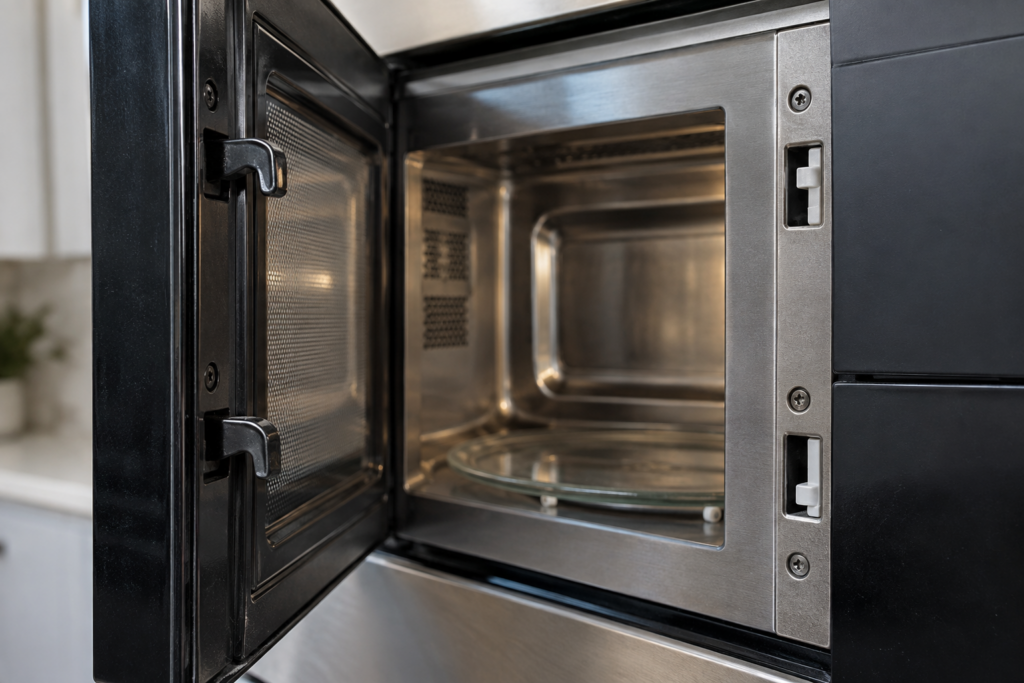
The door interlock is the safety system that guarantees a microwave cannot produce energy with the door open. It is not one switch but a set of them, wired so that the oven checks its own door in more than one way, and the control monitors whether their answers agree. F3 means they no longer do.
There is no owner-side diagnosis worth attempting here and no reason to keep cooking while you wait. Stop using the microwave, switch off its breaker, and have it looked at. Interlock switches are inexpensive parts; the reason they are not a DIY job is that the capacitor inside a microwave holds a dangerous charge long after the appliance is unplugged, which is a hazard unlike anything else in the kitchen. Our guide to appliance electrical safety explains where that line sits across the rest of the house.
SE Means a Button Is Being Pressed Without You
A stuck or shorted key produces SE, and on a control with a membrane keypad the usual cause is physical rather than electronic: grease worked into the panel, a spill that dried under the film, or a cleaning product that swelled the membrane. The control sees a key held down, decides that nothing else can be trusted, and locks out.
- Clear power for a full minute at the breaker. A single transient stick will not come back.
- Clean the panel properly. A barely damp cloth, no spray directed at the panel, and nothing abrasive.
- Press every key once. A key that feels different from its neighbors is usually the offender.
- Do not leave it powered while it reads SE. A shorted key can start a cycle in an empty cavity.
If SE returns after a proper clean, the membrane or the control panel has failed, and that is a part replacement rather than a repair. Worth knowing before you order anything: on most built-in models the keypad and the control board are supplied as one assembly, so the diagnosis decides the cost of the part rather than the labor.
F2 and F5 Are Different Sensors With Different Consequences
F2 is a temperature sensor fault. On models that offer probe or temperature-controlled cooking, that sensor is what decides when a cycle ends, and a faulty one either stops a cycle early or lets it run past the point where food is done. F5 is the humidity sensor, which is what drives automatic modes — the ones where you press a food type rather than a time. When it fails, those modes guess.
There is a practical way to tell which of the two is really misbehaving. If a cycle you set by hand finishes correctly and only the preset food buttons go wrong, the humidity side is the problem. If even a timed cycle stops early, look at the temperature side instead. Neither is a safety fault in the way F3 is, and the practical advice is the same for both: use manual time-and-power cycles until the sensor is replaced, and do not trust an automatic mode that has started producing odd results. A humidity sensor can also be fooled by grease buildup in the cavity, so a thorough clean is a legitimate first step before assuming the part has failed.
F1 Is the Board; PF Is Nothing
F1 reports a control board fault. Owners often report it alongside a display that dims or a fan that keeps running after the door is opened, and both are consistent with a board that is no longer sequencing its outputs correctly. It is the code with the least specific symptom — a microwave that freezes, restarts, ignores keys, or behaves differently each time — because the part that failed is the part that reports failures. A single F1 after a power event may clear with a breaker cycle. A recurring one is a board.
PF is the opposite. It means the appliance lost power, the clock stopped, and it wants you to know. Set the time and move on. If PF appears repeatedly without neighborhood outages, the problem is the circuit feeding the microwave rather than the microwave itself, and that is an electrician's question. The full list, with the diagnosis for each, is in the microwave error code archive.
Where Owner Checks Stop
Clearing power, cleaning the keypad, and degreasing the cavity are the complete list of things worth trying yourself. Everything past that involves the cabinet, and the cabinet holds a charged capacitor. Our Dacor microwave repair service covers interlocks, sensors, and control boards, with a diagnostic from $95 credited toward authorized repair work; the final price is confirmed after the on-site diagnosis and the written estimate comes before any work begins.
If your microwave is showing F3, leave the breaker off and book a visit rather than waiting to see whether the code returns.