 Denys Hargrove
Key Takeaways
- Three of the nine refrigerator codes are airflow faults: E4 is the evaporator fan, E5 the condenser fan, and FF the freezer fan.
- The Dacor refrigerator E4 error code explains the odd pattern owners report — a cold freezer with a warming fresh food compartment.
- E1 and E2 are sensor faults, E3 is defrost; frost on the rear panel behind the bottom drawer tells them apart.
- PF and HI are warnings rather than component failures, but an HI that keeps returning with the doors closed points to another code on the list.
- A dust-choked condenser coil imitates a fan failure and is the one cause an owner can clear without opening the appliance.
The Bottom Line
Read the code as a component, not as a complaint: it names a fan, a sensor, the defrost circuit, or the ice maker. Clear the power, check the condenser and clearances, then have the named part diagnosed rather than replaced on a guess.
A Dacor refrigerator does not announce trouble with a light and a shrug. It puts a short code on the display, and each code points at one component rather than at a general complaint. That is genuinely useful, provided you know which code belongs to which part — and provided you resist the temptation to read a code from a different brand's chart. The list below is the one that applies to DRF36, DRF42, and DRZ36 units.
| Code | What the control is reporting | What you will notice first |
|---|---|---|
| E1 | Compartment temperature sensor failure | Temperatures drift or read implausibly |
| E2 | Freezer compartment sensor failure | Freezer runs warm or over-freezes |
| E3 | Defrost system failure | Frost builds on the rear wall, cooling fades |
| E4 | Evaporator fan motor failure | Fresh food warms while the freezer holds |
| E5 | Condenser fan failure | Whole cabinet warms, compressor area runs hot |
| E6 | Ice maker system failure | No ice, or the maker cycles without filling |
| FF | Freezer fan failure | Freezer softens while the fridge stays cold |
| HI | High temperature warning | An alarm after a door was left open or a fault |
| PF | Power failure alert | Code appears after an outage; contents may have thawed |
Three of Nine Codes Are a Fan
Look at the table again and notice how much of it is airflow. E4 is the evaporator fan, E5 is the condenser fan, and FF is the freezer fan. A column refrigerator is essentially a very well insulated box with two jobs: move cold air around the inside, and move heat away on the outside. When one of those fans stops, the compressor keeps running and the cabinet still fails to hold temperature.
That is why the Dacor refrigerator E4 error code reads so strangely to owners at first. The freezer is fine, the unit is clearly running, and yet the fresh food side is climbing. The evaporator fan is the part that pushes chilled air out of the evaporator housing and into the compartment; without it, the cold stays where it is made.
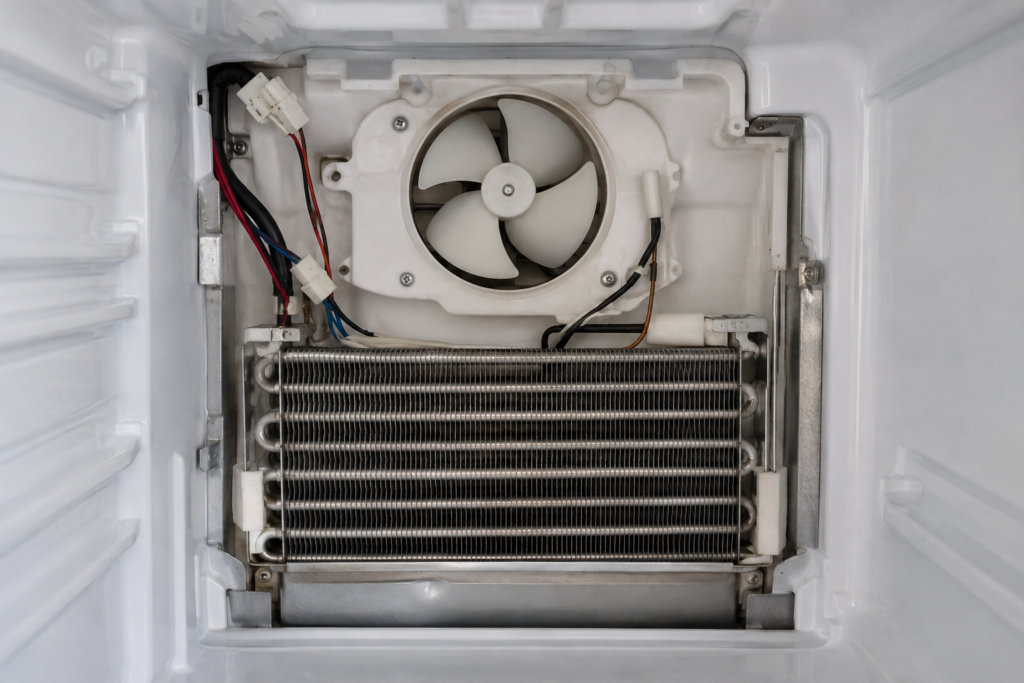
The condenser side behaves differently. With E5, heat is not being carried away from the coils, so the entire cabinet warms and the machine compartment runs noticeably hot. Before assuming a motor has failed, check whether the condenser is simply choked with dust — a clogged coil forces a fan that is still working perfectly well into a losing fight.
Sensors and Defrost Look Alike From the Outside
E1, E2, and E3 produce symptoms that owners describe in almost identical words: the refrigerator is not holding temperature the way it used to. The difference is what the control believes. A sensor fault (E1 or E2) means the board is getting a reading it cannot trust, so it manages the compartment against bad information. A defrost fault (E3) means the board is reading correctly, but frost is accumulating on the evaporator until air can no longer pass through it.
You can often tell them apart without tools. Pull the lowest freezer drawer and look at the rear panel. A wall of white frost behind it points to defrost. A clean panel with wildly wrong temperatures points to a sensor. Either way the repair is behind that panel, and both jobs involve the sealed side of the appliance, which is not owner territory.
PF and HI Are Warnings, Not Faults
These two are the ones worth understanding before you panic. PF is a power failure alert: the appliance is telling you it lost power at some point and cannot vouch for what happened to the contents while it was off. Clear it, then judge the food on its own merits rather than on the display.
HI is a high temperature warning. It appears when the compartment has been above its target long enough to matter — after a door was left ajar, after a large warm load, or as a consequence of one of the fan or defrost faults above. If HI clears on its own within a few hours and never returns, it did its job. If HI keeps returning with the doors closed, treat it as a symptom of something else on this list, and read our guide to a refrigerator that is not cooling alongside it.
What to Check Before You Call
Four checks take ten minutes and occasionally save the visit entirely. None of them require opening anything sealed.
- Cycle the power. Switch the breaker off for a full minute. A code that never comes back was a transient, most often after an outage.
- Look at the condenser. Dust on the coil mimics a fan failure and is the one cause an owner can genuinely fix.
- Check clearances. A column unit crammed against cabinetry cannot exhaust heat, and it will keep throwing warnings until it can.
- Listen at each compartment. Air movement you can hear on one side and silence on the other tells you which fan the code is about.
- Write down what you saw. The code, the time, and which compartment was affected — that note shortens the diagnosis considerably.
The full list, with the diagnosis for each, sits in the refrigerator error code archive.
When It Needs a Technician
Fan motors, defrost heaters, thermistors, and control boards in a built-in column are not parts to swap by guesswork; several of them sit behind panels that have to come off in a particular order, and a wrong diagnosis means a second visit. Our Dacor refrigerator repair service covers the whole cooling and control chain, and the diagnostic starts from $95, credited toward authorized repair work. The final price is confirmed after the on-site diagnosis, with a written estimate before anything begins.
If the cabinet is warming and food is at risk, move what matters to another appliance first and book a visit second. A refrigerator that has lost cooling does not improve while it waits.