 Denys Hargrove
Key Takeaways
- A rangetop ignition repair starts from $225 on our IGN-FAIL page, and a diagnostic visit starts from $95.
- On the HRTP rangetops, one shared module fires every spark electrode, so a module failure takes out all the burners.
- Grease on an electrode, a wet cap or a misaligned cap cause the same clicking and cost nothing to rule out.
- Ask the technician to test each burner and name the failed part on the estimate.
- Do not rely on a burner that clicks without lighting: switch it off, ventilate and resolve the fault.
The Bottom Line
Clean and dry the burner caps first, then ask for a diagnosis that tests each burner. The final price is confirmed on site, with a written estimate before work begins.
The Dacor re-ignition module replacement cost depends less on the part than on whether the part is really the problem. A gas burner that clicks and will not light, or that clicks on and on after it has lit, is blamed on the module quickly, yet a wet electrode, a burner cap sitting off its base or a grease-bridged gap produces exactly the same noise. This guide sets out what the site publishes on the ignition module, what the repair starts at, what you can rule out for nothing first, and what to ask for on the estimate so that you pay for the part that failed.
| What you notice | Likely cause | Cost note |
|---|---|---|
| One burner clicks and will not light | Dirty, wet or misaligned electrode or cap | No cost if cleaning fixes it |
| Cracked white ceramic on an electrode | Failed electrode | Part and labor |
| Every burner clicks and none lights | Shared ignition module or gas supply | Repair from $225 |
| Diagnosis before any part is ordered | Tests each burner in turn | From $95 |
How Much Does a Dacor Re-Ignition Module Replacement Cost?
Our rangetop ignition page puts a repair from $225, with a professional visit of 45 to 90 minutes, and a diagnostic visit starts from $95. That is a starting figure and not a quote, because the same page covers cleaning, an electrode and the module, and the module is the dearest of the three. The final price is confirmed after diagnosis on site, with a written estimate before any work begins.
It is also worth remembering what the starting figure leaves out. If the diagnosis finds a burner valve, a damaged cap or a gas supply problem alongside the module, each of those is a separate item on the estimate, and a gas supply fault is the utility's or a gas fitter's job and not an appliance repair. A short list of findings on a written estimate is easier to approve than a single number you cannot check.
The phone price is never the real price. Ask the technician to test each burner in turn, since a single stuck burner and a failed shared module are different jobs with different parts, and only the test tells you which one you have.
What Is a Re-Ignition Module on a Dacor Range?
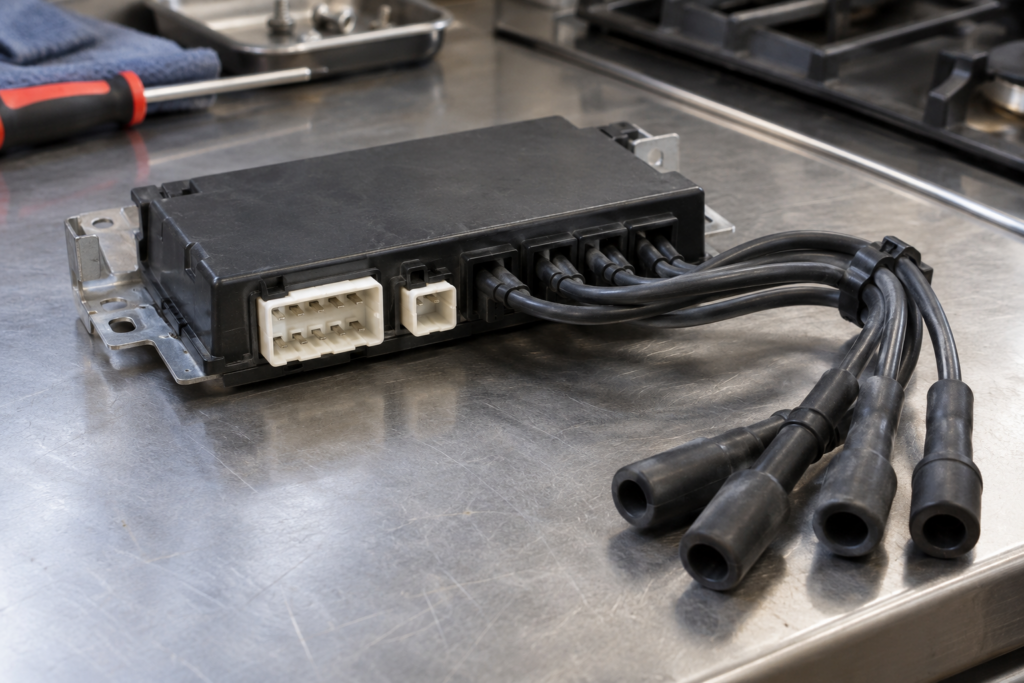
The phrase is how owners search for it. The part our pages describe is the ignition module, the electronic module that controls the spark to the burners, and it is a different part from the electrodes at the burner heads. On the site's IGN-FAIL page, the HRTP366S and HRTP486S rangetops share a common ignition module, so turning on one burner fires every spark electrode at once. Our pages do not use the phrase re-ignition module, and whether yours also relights a burner that goes out depends on the model, so check the handbook for your model number.
That shared design is why the module matters to the price. When it fails, every burner goes with it, and the repair is larger than replacing an electrode.
Is It the Module or Something Cheaper?
Usually it is something cheaper, and the checks cost nothing. The IGN-FAIL page names grease on the electrode or burner cap as the first cause, a misaligned cap as the second, and a cracked electrode or burned-out module as the one that needs a technician.
- Clean the cap and electrode with a soft brush and warm soapy water, scrubbing the underside of the cap, then rinse.
- Let it dry for at least 30 minutes. The page says moisture trapped under a heavy sealed-burner cap suppresses the spark.
- Reseat the cap flat and centered. It should not wobble when you rock it.
- Look at the white ceramic of the electrode in good light for hairline cracks, which let the spark arc to ground.
- Try a match. If the burner lights with a flame held to the port, gas is flowing and the fault is in the spark system.
The page's guidance on when to call is specific: a cracked ceramic, a burner that will not light even with a match, or all six burners on the HRTP486S failing to ignite after thorough cleaning, where it says the ignition module is likely.
What Decides the Final Price
Three things set the estimate apart from the starting figure.
- Which part failed — an electrode, the module or the wiring between them are separate parts.
- How the range is installed — access to the module is easier on some installations than others, and harder access adds labor.
- Model and part number — modules are matched to the model, so a wrong part wastes a visit.
Our guide to Dacor cooktop igniter repair cost covers the single-electrode case in more detail, and the range repair cost guide gives the wider picture.
What the Visit Involves
The order of work explains why diagnosis comes before a quote. A technician starts at the burner heads and works back toward the module, and each step either closes off a cheaper cause or confirms the dearer one.
- Spark test, burner by burner — one burner sparking weakly points at its electrode, and none sparking points at the shared module.
- Electrode inspection — the ceramic is checked for cracks and the tip for wear, grease and corrosion.
- Cap and gap check — a cap that is not seated, or residue bridging the gap, is cleared first.
- Gas flow check — if a burner lights with a flame held to it, gas is reaching it and the fault is in the spark system.
Only after those does the module get replaced, followed by a test of every burner. If the estimate arrives before the technician has done those tests, ask what it is based on.
Is It Safe to Use the Range Until the Module Is Replaced?
Not by relying on the igniters. The IGN-FAIL page says a burner that clicks without lighting should not be left running, because gas flows to the burner during the attempt, and it says not to try more than three times in a row. Turn the knob off, ventilate the kitchen and resolve the fault before cooking on that burner again.
If there is no gas smell and the burner lights promptly with a match, some owners light it by hand for a day or two while a visit is booked. That is a stopgap and not a plan, and a gas smell at any point means turning everything off and leaving, as covered in our rangetop gas smell safety guide.
What to Ask for on the Estimate
A written estimate should name the part and the labor separately. Ask which test showed the module was at fault, whether the part is genuine and matched to your model number, and what the repair carries as a guarantee. The rangetop repair service covers modules, electrodes and valves. You can book a visit or send us the model and what the burners do.