 Denys Hargrove
Key Takeaways
- Dacor refrigerator condenser coil cleaning should happen twice a year, and every three months with pets or heavy frying.
- On built-in columns the coils usually sit behind a ventilation grille at the base; your use-and-care guide shows the exact spot for your model.
- Unplug the refrigerator first, use a vacuum and a soft brush, and never water, spray cleaner, or compressed air.
- Debris on the coils or fan can contribute to the E5 condenser fan code, which this site rates as high severity.
- A hot, burnt smell or a fan that will not turn after cleaning is a reason to unplug the unit and call.
The Bottom Line
Fifteen minutes with a vacuum and a soft brush twice a year keeps the compressor cool and the E5 code away. Keep the grille clear, and call if the fan will not turn after cleaning.
Behind the grille at the base of a built-in refrigerator column, a set of coils is quietly getting rid of the heat your food gave up. When dust, pet hair, and kitchen grease coat those coils, the compressor has to run longer to do the same job, the compartment behind the grille gets hotter, and one day the refrigerator cycles off on overload and starts to warm. A few minutes of cleaning twice a year prevents all of that, and it is routine upkeep that stays with the owner.
| Situation | How often to clean | What to look for |
|---|---|---|
| Typical home, no pets | Twice a year | Light gray dust on the coil face |
| Dog or cat in the house | Every three months | Hair matted into the fins or on the fan blade |
| Open kitchen with heavy frying | Every three to four months | Sticky film that traps dust |
| Renovation or sanding nearby | After the work is finished | Fine dust packed deep in the fins |
| Warm compartment behind the grille | Now, before anything else | Hot air, hum that never stops |
Where Are the Condenser Coils on a Dacor Refrigerator?
On most built-in Dacor refrigerator and freezer columns the condenser coils sit in the machinery compartment behind a ventilation grille, usually at the base, though your use-and-care guide shows the exact place for your model. This site's code page for the E5 condenser fan fault describes the same area as the mechanical compartment at the rear or bottom of the unit, with the condenser fan next to the coils. That fan pulls room air through the coils and pushes the heat out, so the grille must stay clear of boxes, mats, and anything stored against it.
If you are unsure which panel is the grille, look for slots rather than a smooth surface. Do not remove a panel that is screwed on behind the cabinet; a grille that clips or lifts off by hand is the one meant for you.
How Often Does Dacor Refrigerator Condenser Coil Cleaning Need to Happen?
Twice a year is the right default, and every three months if you have a pet that sheds or you cook with a lot of oil. The table above shows the common cases. A built-in column does not move, so dust that lands on the coils stays there, and the hotter the room, the harder the compressor works against it. A quick look when you change a smoke detector battery is an easy way to remember.
The same rule applies to a refrigerator in a pantry-style alcove or behind panels, where air circulates less. If the installer left only the minimum clearance, clean more often and make sure nothing blocks the grille.
The Cleaning Routine, Step by Step
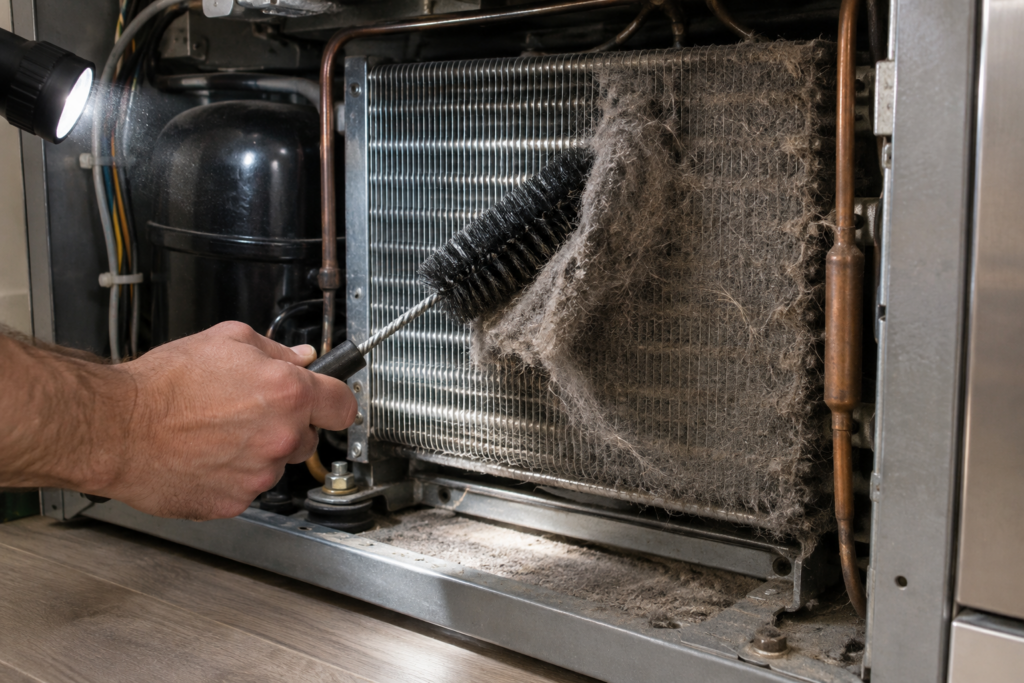
The whole job takes about fifteen minutes with a vacuum, a soft brush, and a flashlight. Never use water, spray cleaner, or compressed air that can blow debris into the fan.
- Unplug the refrigerator, or switch off its breaker, before anything else; the fan is live while it is connected.
- Lift or unclip the ventilation grille and set it aside; do not force a panel that is screwed in.
- Look first with a flashlight. Note how thick the dust is and whether anything has fallen behind the coils.
- Vacuum the coil face with a brush attachment, moving along the fins rather than across them.
- Use a long, soft coil brush to loosen packed hair, then vacuum again until nothing comes away.
- Wipe the fan blade with a dry cloth, taking care not to bend it, since a wobbling blade makes noise and moves less air.
- Clean the floor and the grille where dust settled, then put the grille back until it clicks.
- Restore power and listen. You should hear the fan and compressor start normally within a few minutes.
Bent fins reduce airflow, so if you straighten any, use a fin comb gently and stop if the metal resists. Do not chase deep corners with a screwdriver.
Check the fan at the same time. With the refrigerator unplugged, turn the blade gently by hand: it should spin freely and without grinding. A blade that sticks, rubs, or carries a wad of hair is one of the most common reasons a refrigerator runs hot, and removing the obstruction costs nothing. If the blade is loose on its shaft, cracked, or does not turn smoothly, stop there and have it replaced rather than running it.
Can Dirty Coils Trigger the E5 Code?
Yes, dirty coils can contribute to E5, although the code itself points at the condenser fan circuit. The Dacor refrigerator E5 error is listed on this site as a condenser fan fault on the DRF36, DRF42, and DRZ36 models, and its stated causes include debris that has jammed the fan blade or built up on the coils and triggered overload protection. The typical signs are a compressor that cycles off on thermal protection after running briefly, a very warm machinery compartment, and slowly rising temperatures in both the fresh-food and freezer sections.
- Cleaned coils, code gone: debris was the cause, and your routine has solved it.
- Cleaned coils, blade clear, fan still not turning: the fan motor has failed and needs replacing.
- Scorched smell or discolored wiring near the fan: unplug the refrigerator and call, do not restart it.
The E5 page rates the fault as high severity and says to unplug the unit until it is repaired if the fan is not working, because a compressor without a fan can overheat and be damaged permanently.
What Else Keeps the Compressor Cool Between Cleanings?
Clearance, airflow, and a sound door seal all matter nearly as much as the coils. A refrigerator that has to fight a leaking gasket also runs longer, so pair coil cleaning with a look at the door seal, and read our guide to Dacor refrigerator door seal care. For the wider routine, our refrigerator care and cleaning guide covers the interior, the filter, and the dispenser.
- Keep the grille area clear of storage boxes, floor mats, and cleaning supplies.
- Vacuum the floor around the base every month so dust never reaches the coils in the first place.
- Do not stack heat sources next to the column, such as a dishwasher vent or a warming drawer.
- Listen for a change in sound: a louder, longer hum usually means the unit is working harder.
When to Call Instead of Cleaning
Call if the compartment smells hot or burnt, if the refrigerator warms even after cleaning, or if E5 returns. Our guide to a Dacor refrigerator that is not cooling lists the other causes, and if food has warmed, our article on refrigerator temperature safety explains what is safe to keep. A technician from Dacor refrigerator repair can also add coil cleaning to a preventive maintenance visit. When you are ready, schedule a visit; the final price is confirmed after diagnosis, with a written estimate before work begins.