 Denys Hargrove
 Key Takeaways
- The Dacor oven F4 error code means the temperature sensor returned a reading the control board considers out of range while the oven was cooking.
- F4 usually appears 20 to 40 minutes into a bake, unlike F3, which fires at startup when the sensor circuit is open or shorted.
- A thermometer on the middle rack at 350°F tells you whether the sensor has drifted: a gap of more than 25 degrees is the signal.
- The oven can usually still be used briefly with a thermometer in the cavity, but stop if F4 appears on every cycle or food burns at a normal setting.
- The control board is the last suspect, not the first; a drifted sensor or a loose connector is far more common.
The Bottom Line
Treat F4 as a sensor you can no longer trust, not as a dead oven. Run the thermometer test, note when the code appears, and have the sensor tested under heat before anyone talks about the board.
The Dacor oven F4 error code tends to appear in the middle of a long bake rather than at startup, and that timing is what makes it confusing. The oven heats, the recipe goes in, and twenty or forty minutes later the display flashes F4 while the food comes out either pale or overdone. Nothing is obviously broken, which is exactly why owners reset it, ignore it, and then meet it again on the next roast.
| What you notice | What it usually points to | Safe next move |
|---|---|---|
| F4 flashes only after 20 to 40 minutes of baking | Temperature sensor drifting once it is hot | Run the thermometer test below and note the time it appears |
| Oven runs well above or below the set temperature | Sensor reading no longer matches the real cavity | Stop relying on the display; cook by an oven thermometer |
| F4 comes and goes, never the same twice | Loose or corroded sensor connection | Power cycle once, then book a diagnostic if it returns |
| Wide temperature swings, long cold gaps | Board reacting to bad sensor data | Do not keep cycling power; have it tested |
| F4 on every cooking mode, every time | Fault has settled into hardware | Book a visit instead of cooking around it |
What Does the Dacor Oven F4 Error Code Mean?
F4 means the oven's temperature sensor is returning a reading outside the range the control board considers plausible while the oven is actively cooking. This site's own code page lists it as a medium-severity fault: the oven can still heat, but its idea of the cavity temperature can no longer be trusted. The sensor involved is the resistance temperature sensor (RTD) that sits inside the oven cavity, and the board reads its resistance continuously to decide when to switch the elements on and off.
When the sensor drifts, the board makes decisions from wrong numbers. It may hold the elements on too long and scorch the top of a casserole, or cut them early and leave a roast undercooked, and each correction swings the oven further from the setting. That is why the first complaint is usually a recipe that stopped working rather than a code on the display.
How Is F4 Different From the F3 and F2 Codes?
F3 is the harsh version, F4 is the subtle one, and F2 is a different problem altogether. F3 fires at startup when the sensor circuit is open or shorted, so the oven refuses to heat at all and the display shows dashes instead of a temperature. F4 only appears during cooking, when a sensor that looked fine at room temperature starts reporting values that do not make sense once it is hot. F2 is an over-temperature event, which means the cavity actually exceeded its limit; our page for the F2 over-temperature code explains that case.
- F3 at startup means the board cannot read the sensor at all; see the F3 temperature sensor page.
- F4 mid-bake means the reading arrived but looked wrong once the oven was hot.
- F2 with burnt food means the oven really did run too hot, which is a safety matter, not a calibration one.
- F1 points at the control board itself and behaves differently again, usually with an oven that stops responding.
If your display has shown more than one of these on different days, tell the technician every code and roughly when each appeared. Together they narrow the fault faster than any single code.
A Thermometer Test You Can Run Tonight
You can check whether the sensor has drifted with an inexpensive oven thermometer and about half an hour. Nothing here involves opening a panel or touching wiring.
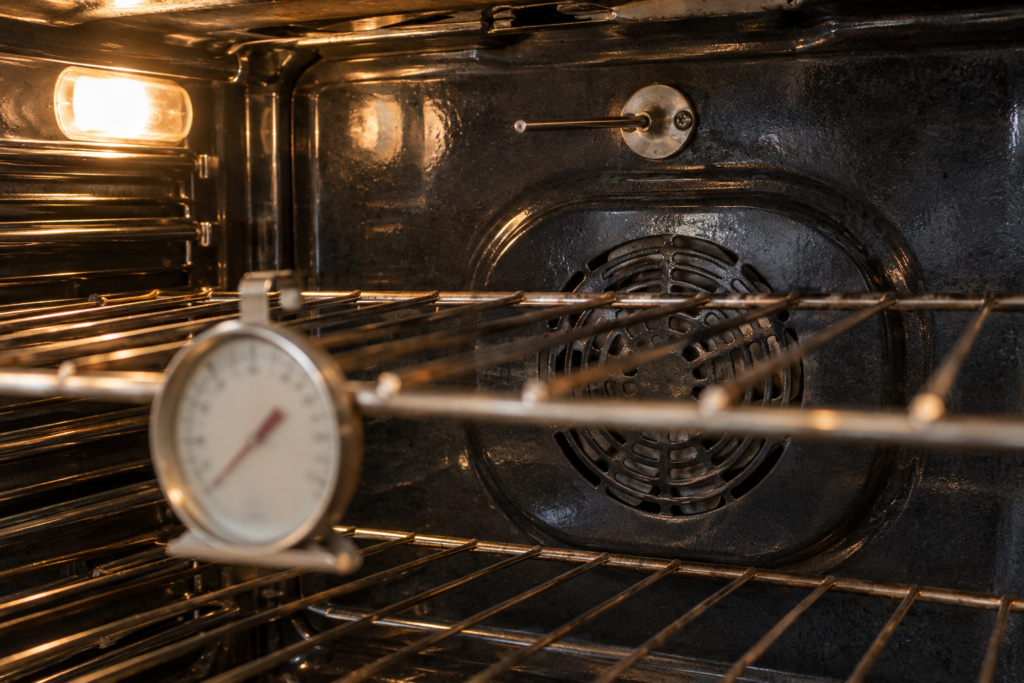
- Place an oven-safe thermometer in the center of the middle rack, where you can read it through the window or by opening the door briefly.
- Set the oven to 350°F on a plain bake setting and leave the door closed.
- Wait a full 20 minutes after the oven announces it is preheated, because the sensor and the cavity need time to settle.
- Read the thermometer and compare it with the setting. A gap of more than 25 degrees suggests the sensor is drifting.
- Repeat once at 400°F if the first result looks borderline, since some sensors only misread at higher temperatures.
- Write down the times F4 appears. A fault that shows up after the same number of minutes each time is a strong clue for the technician.
Reseating the sensor connector is a job for a technician. The connector sits behind panels with the circuit live unless the breaker is off, and a corroded pin can look healthy until it is tested under heat.
Can You Keep Cooking With F4 Showing?
Usually yes for a short while, but only with a thermometer in the oven and your eyes on the food. The code page rates it as a maybe rather than a no: the elements still switch, so the oven does not become dangerous the way an F2 over-temperature fault can. What you lose is accuracy, and long bakes such as bread, roasts, and anything with a custard center are where that shows up first.
Stop using the oven if F4 appears on every cooking cycle without exception, if the oven is visibly burning food at a normal setting, or if it smells of scorching. In any of those cases the board is acting on readings it should have rejected, and the sensible move is to switch the oven off at the breaker and arrange a visit.
Does F4 Mean the Control Board Has to Be Replaced?
Rarely as a first conclusion. The code page lists three causes in order of how common they are: a sensor whose resistance has drifted, an intermittent connection at the sensor or the board, and a corrupted temperature correction table on the board itself. The first two are inexpensive. Only when a good sensor on a clean connection still produces F4 does the board come into the picture, which is why a technician will test the sensor under heat before quoting a board.
- Drifted sensor: reads correctly cold, wanders when hot; replacing it is the usual fix, and a sensor replacement starts from $125 at our company.
- Intermittent connection: the code appears and disappears with no pattern; cleaning or replacing the connector solves it.
- Board calibration fault: the sensor tests perfectly and F4 still returns; this is the case that needs the board addressed.
The final price depends on your model and what the technician confirms on site, and you get a written estimate before any work starts.
Getting the Sensor Circuit Checked
Our Dacor oven repair service tests the sensor under real operating heat, which is the one thing a cold resistance reading cannot do. If the oven is also slow to heat, read our guide to a Dacor oven not heating, and if it has been beeping, our article on an oven beeping with an F2 code covers the related alarm. When you are ready, book a visit and mention the exact minutes F4 appears; it shortens the diagnosis.