 Denys Hargrove
Key Takeaways
- E3 means the convection fan motor is not reaching its operating speed, and a reset will not fix it.
- Standard bake and broil still work, so avoid convection modes until the fan is repaired.
- Clear any debris and spin the blade by hand with the oven cool and the breaker off.
- A motor repair is usually worth doing on an otherwise sound oven, a board fault is a bigger decision.
The Bottom Line
Check the fan for debris and spin the blade by hand. If the motor has failed, repair it rather than replace the oven, unless the oven has other faults or the estimate includes a board.
An oven that bakes well in plain mode and badly in convection is often a convection fan problem, and Dacor ovens tell you so with E3. The E3 code page on this site describes a convection fan motor that is not reaching its required operating speed. The oven still works, which is what makes the question awkward: it is a fault you can live with, so is it worth paying to fix, or is it the first sign of an oven that is wearing out? This guide helps you decide. For the bigger question about the whole oven, the parent guide is Dacor oven repair or replace.
| What you find | What it means | Fix or replace? |
|---|---|---|
| Debris or foil caught in the fan housing | A physical blockage | Fix, clear it |
| Cracked or missing blade | Out-of-balance fan | Fix, replace the blade or fan |
| Blade intact and spins freely, motor will not run | Failed motor winding or wiring | Fix, replace the motor |
| New motor fitted and E3 persists | Control board fan circuit | Weigh the board against the oven's age |
What Does E3 Mean on a Dacor Oven?
It means the convection fan motor is not getting up to speed, so the oven cannot circulate heat evenly. The page rates it medium severity and says standard bake and broil still work, while convection modes produce uneven results. A reset will not help, because a failed motor needs physical replacement.
The symptoms on the page fit one pattern. Food browns unevenly on convection bake, with one side done and the other pale. E3 appears when a convection mode is selected. There is no audible airflow from the rear of the cavity. Convection modes are blocked while plain bake still runs. If you see all four, the fan circuit is the problem and the heating elements are not.
What Can You Check Before Deciding?
Two checks, both with the oven cool and the breaker off, and both from the E3 page. They are quick and they sort out the cheap causes from the expensive ones.
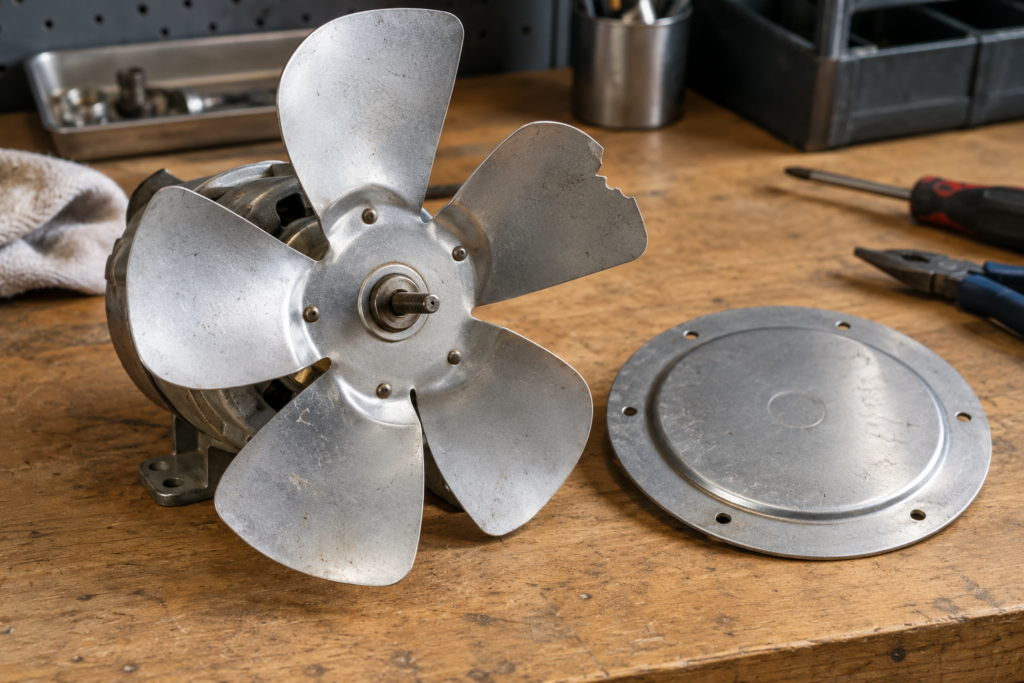
- Look behind the fan cover — the page says the rear fan cover is typically held by one center screw or a quarter-turn fastener, so check for a cracked or chipped blade and for debris between the blade and housing.
- Spin the blade by hand — it should turn freely with no grinding or scraping.
- Clear anything that is in the way — a fallen rack, a piece of foil or food debris can stop the blade.
- Reset at the breaker for five minutes — then select convection bake at 350°F and listen for the fan to spin up within 10 seconds of the element activating.
The page adds a reading that helps the decision. If the fan starts and then slows or stops, the motor bearings are failing, which points at a motor replacement rather than a blockage. If it never starts at all and the blade spins freely by hand, the motor winding or its wiring is the suspect.
Is It Safe to Keep Using the Oven With E3?
Yes in standard bake and broil, and no in convection modes. The page says to avoid convection until the fan is repaired, because the oven cannot hold even heat without it and results will be unpredictable. It also lists a stop sign: grinding or scraping from the fan area in any cook mode, since a damaged blade can detach.
Living with E3 for a while is therefore possible. The cost is a slower oven and less reliable results for the roasting, baking and multi-rack cooking that convection is for. Weigh that against the price of the repair when you decide how soon to book.
Dacor Oven Convection Fan Fix or Replace: What Decides It
When you weigh a Dacor oven convection fan fix or replace, the answer is usually to fix it, as long as the oven is otherwise sound. The E3 page lists a typical professional repair from $175 and 45 to 75 minutes, and rates about 30 percent of cases as fixable by the owner, with motor replacement itself as technician work. The final price is confirmed after on-site diagnosis, with a written estimate before work begins.
The page says a seized motor is common after 8 to 12 years of use on several Dacor oven lines. That is the age bracket where the decision gets harder, and these are the points to weigh:
- Condition of everything else — a fan motor on an oven with a sound control board, good door seal and working elements is a good repair.
- Other faults in the last few years — a second or third repair of a different kind suggests an oven near the end of its life.
- How much you use convection — if you rarely use it, living with E3 for now is a real option.
- The estimate for a board — if a new motor does not clear E3, the page points to the control board's fan circuit, which is a much bigger bill.
It also helps to picture the alternative. Replacing a built-in wall oven means a new unit that fits the same cabinet opening, a delivery, and an electrician or installer for the dedicated 240V supply. Set that beside a repair that the page puts at under an hour and a quarter of technician time, and a fan fault on its own seldom justifies replacing the oven. Ask for the written estimate, compare it with the age and condition of the oven, and decide from that number rather than from the code.
What the Visit Involves
The page says motor replacement means accessing the rear panel of the oven cavity and disconnecting internal wiring, which is why it recommends a professional. A technician from our oven repair service reads the codes, tests the motor and its circuit and confirms the part before ordering. Note that E2 is a different fan, the cavity cooling fan, on a separate code page.
Before the visit, collect four things, because each narrows the cause:
- Which modes trigger E3 — the page says the code appears when a convection mode is selected.
- Whether the fan moves at all — dead, slow or starting and stopping point to different failures.
- Any grinding, scraping or burning smell — they change how urgent the visit is.
- What you already cleared or reset — debris, the fan cover and the five-minute breaker reset.
With those, the technician can arrive with the likely part and finish in one visit. Our oven repair cost guide shows how a fan repair compares with the other common faults, and the oven worth repairing guide covers age. When you are ready, book a visit or send us the model number and what the fan does.